
Vagus Nerve Exercises: 5 Somatic Resets for Nervous System Regulation
Vagus nerve exercises are physical, bottom-up somatic techniques designed to activate the tenth cranial nerve—the primary biological brake of the parasympathetic nervous system. Because 80% of vagal nerve fibers are sensory (afferent), carrying signals from the body up to the brain, targeted motor inputs like suboccipital decompression, auricular massage, and extended exhalations mechanically trigger acetylcholine release. This slows heart rate, dilates peripheral vasculature, and pulls the autonomic nervous system out of sympathetic hyperarousal or dorsal shutdown within 60 to 90 seconds.
It is 3:45 on a Tuesday afternoon. You are sitting at your desk or looking down at your phone. There is no bear standing in your doorway, no fire alarm ringing, and no immediate threat to your survival.
Yet your chest feels tightly cinched, as if an iron band has been strapped around your ribs. Your masseter jaw muscles are clamped so hard your molars ache. Your breath is short, shallow, and trapped in your upper collarbones, and your heart is hammering at ninety-five beats per minute.
You try to reason with yourself: "Relax. It is just an email. Calm down. Everything is fine."
You repeat the mantra ten times. But your pulse does not drop by a single beat. In fact, arguing with your racing mind only makes you feel more frustrated and out of control.
Why does cognitive logic fail so completely when you are overwhelmed? Because you are trying to solve a hardware problem with software. You are attempting top-down cognitive reframing on an autonomic nervous system that is locked in biological survival alarm.
The Neurobiological Reframe:
Eighty percent of the nerve fibers in your vagus nerve are afferent—meaning they carry information from your visceral organs upward to your brain, not the other way around. When your heart is racing and your gut is clenched, your body screams "DANGER" to your brainstem sixty times a second. You cannot talk your heart down; you must give your body physical, somatic proof of safety through the vagal brake.
Why you cannot "think" your heart rate down: bottom-up vs top-down regulation
Modern culture teaches us that thoughts control emotions. We are told that if we change our mindset, reframe our cognitive distortions, or repeat positive affirmations, our bodies will obediently settle down.
While Cognitive Behavioral Therapy (CBT) is an extraordinary tool for evaluating beliefs in a calm state, it is virtually useless during acute autonomic dysregulation. When your sympathetic nervous system detects threat, it down-regulates blood flow to the prefrontal cortex—the center of logic, planning, and language. Concurrently, it hands command of your physiology over to the primitive amygdala and brainstem.
In this state, your brainstem does not speak English, Hindi, or French. It does not understand rationale or deadlines. It speaks only the primitive language of neuroception—subconscious sensory inputs from eye gaze, muscle tone, facial expression, vocal resonance, and breathing cadence.
To stop acute panic, chronic dread, or functional paralysis, you must bypass the thinking mind and apply bottom-up somatic regulation. You must physically stimulate the primary nerve trunk that controls your heart, lungs, and gut: the vagus nerve.
The biological brake: anatomy of the 10th cranial nerve and the Polyvagal hierarchy
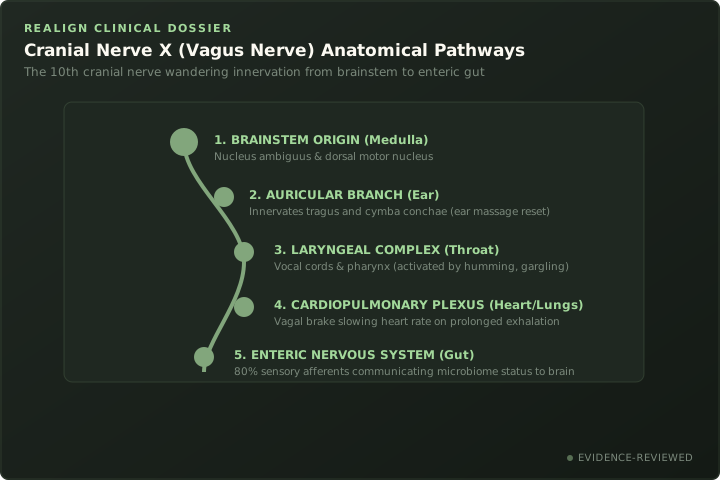
The vagus nerve (Cranial Nerve X) is the longest cranial nerve in the human body. The word vagus originates from the Latin word for "wanderer"—the same root as vagabond. Starting at the brainstem's medulla oblongata, it exits the base of your skull through the jugular foramen and travels down through your neck, wrapping around the vocal cords, hugging the carotid artery, weaving through the cardiac plexus, innervating the diaphragm, and branching throughout your stomach, intestines, and spleen.
In the landmark work of Dr. Stephen Porges (originator of Polyvagal Theory), the autonomic nervous system operates not as a simple on/off switch, but in a three-stage evolutionary hierarchy:
- Ventral Vagal Complex (Social Engagement & Calm): The phylogenetically newest, myelinated branch of the vagus nerve. When active, it acts as a "vagal brake" on the heart's sinoatrial node, keeping resting heart rate between 60 and 75 bpm, relaxing facial muscles, enabling eye contact, and fostering emotional safety.
- Sympathetic Nervous System (Fight or Flight): Mobilization response. Adrenaline and noradrenaline flood the bloodstream, bronchodilation occurs, blood is shunted to large limb muscles, and heart rate accelerates.
- Dorsal Vagal Complex (Immobilization & Freeze): The ancient unmyelinated branch. When sympathetic mobilization fails or danger feels inescapable, this system triggers metabolic shutdown: bradycardia, gut paralysis, profound lethargy, and emotional dissociation (see our guide on functional freeze).
When you practice vagus nerve exercises, you are not doing mystical energy work; you are mechanically sending electrical impulses through cranial nerve branches that release acetylcholine—the neurochemical neurotransmitter that decelerates cardiac pacemaker cells and halts sympathetic overdrive.
Below are 5 clinically validated somatic exercises you can perform anywhere in two to three minutes.
Exercise 1: The Basic Exercise (suboccipital release for atlas-axis alignment)
Developed by renowned Danish bodyworker and craniosacral therapist Stanley Rosenberg, this is the gold standard exercise for restoring ventral vagal function. It targets the suboccipital muscles (rectus capitis posterior and obliquus capitis) located at the junction of the skull and the first two cervical vertebrae (C1 atlas and C2 axis), directly adjacent to the jugular foramen where the vagus nerve exits the cranium.
How to Perform The Basic Exercise:
- Lie flat on your back on a firm bed, yoga mat, or sofa. You can also perform this seated with your back straight against a chair.
- Interlace your fingers behind your head, cupping the curved base of your skull (your occipital ridge). Allow your elbows to fall open naturally to the sides.
- Keep your head completely motionless, with your nose pointing straight up toward the ceiling.
- Without turning your head or tilting your neck, shift only your eyes as far to the right as is comfortable, as if trying to look at your right elbow.
- Hold your gaze steady at the extreme right for 30 to 60 seconds. Keep breathing normally.
- Wait for an involuntary neurological release signal: a spontaneous deep sigh, a swallow, or a yawn. Once it happens, bring your eyes back to center.
- Repeat the exact same sequence to the left: keep your head centered and look with only your eyes to the far left for 30 to 60 seconds until you swallow, sigh, or yawn.
Why it works: The suboccipital muscles contain the highest density of muscle spindles in the entire human spine (up to 36 spindles per gram of tissue). Chronic digital posture and stress cause chronic suboccipital hypertonicity, compressing cranial nerves. Coordinated lateral eye movements without head rotation reflexively inhibit suboccipital muscle tone, freeing the jugular foramen and restoring bilateral vagal blood supply.
Exercise 2: Auricular vagus nerve stimulation (the concha and tragus reset)
Most of the vagus nerve is buried deep inside the neck and torso, making direct physical touch impossible. However, there is one profound anatomical exception: the Auricular Branch of the Vagus Nerve (ABVN), historically known in clinical neurology as Arnold's nerve.
The auricular branch surfaces directly underneath the skin in the outer ear, specifically inside the hollow bowl of the ear (the cymba conchae) and the inner surface of the cartilage flap covering the ear canal (the tragus). Medical research has proven that transcutaneous auricular vagus nerve stimulation (taVNS) powerfully elevates Heart Rate Variability (HRV) and reduces systemic inflammation.
How to Perform Auricular Vagal Massage:
- Warm your index fingers and thumbs by rubbing them together for five seconds.
- Place your index fingertip into the deepest curved cavity of your ear, just above the ear canal (the cymba conchae).
- Apply gentle, firm circular pressure against the skin in tiny clockwise circles for 30 seconds. Do not insert your finger into the ear canal itself; press into the curved cartilage bowl.
- Next, use your thumb and index finger to gently pinch the tragus (the small, thick cartilage flap directly in front of your ear opening). Apply gentle rhythmic pulses for 30 seconds.
- Finish by gently pulling your earlobes downward and slightly outward, breathing slowly through your nose.
Why it works: Stimulating the cutaneous fibers of Arnold's nerve sends immediate afferent electrical signals straight into the nucleus tractus solitarii (NTS) in the brainstem. The NTS coordinates parasympathetic output across all internal organs, acting as an instant manual dimmer switch on stress hormones.
Exercise 3: The Salamander Technique (thoracic opening and lateral gaze)
When you are anxious, your shoulder girdle instinctively rises to shield your carotid arteries, and your ribcage stiffens. This postural armor restricts the excursion of your phrenic nerve and diaphragm.
The Salamander exercise combines lateral spinal flexion with counter-directional eye tracking to mobilize the sternocleidomastoid (SCM) and the spinal accessory nerve (Cranial Nerve XI), which shares neural wiring with the ventral vagus.
How to Perform the Salamander:
- Sit comfortably upright on a chair with your feet flat on the floor and hands resting on your thighs.
- Without lifting your left shoulder, gently tilt your head to the right, bringing your right ear toward your right shoulder. Do not force the stretch; go to comfortable resistance.
- Once your head is tilted to the right, shift both of your eyes upward and to the left (toward the ceiling in the opposite direction of the tilt).
- Hold this posture for 30 to 45 seconds while taking slow, natural breaths.
- Wait for a swallow, deep exhale, or salivation. Slowly bring your head and eyes back to center.
- Repeat on the other side: tilt your left ear toward your left shoulder, and look with both eyes upward and to the right for 30 to 45 seconds.
Why it works: Combining lateral cervical flexion with opposing gaze angles breaks the ocular-cervical bracing reflex that locks your upper spine in sympathetic vigilance during screen work or anxiety episodes.
Exercise 4: Low-frequency vocal resonance (laryngeal "vooh" vibrations)
Pioneered by trauma specialist Dr. Peter Levine (creator of Somatic Experiencing), prolonged low-frequency vocalization directly vibrates the motor branches of the vagus nerve.
The vagus nerve directly innervates the muscles of your larynx (voice box) and pharynx (throat) via the recurrent laryngeal nerve and superior laryngeal nerve. When you vocalize a low, sustained sound, the acoustic vibrations travel through the tissue of your throat and chest, directly massaging the vagal nerve trunk and cardiac plexus.
How to Perform the "Voo" Sound Exercise:
- Sit comfortably with your spine tall and rest your right palm flat against your sternum (center of your chest).
- Take a soft, quiet nasal inhalation into your lower abdomen for 4 seconds.
- On the exhalation, make a deep, low-pitched, foggy-day foghorn sound: "Vooooooooooooooh".
- Focus on sustaining the sound gently until your air is almost depleted (aim for 10 to 14 seconds). Do not strain or run out of breath completely.
- Feel the tactile physical buzzing beneath your palm against your breastbone and in your throat.
- Pause in silence for two seconds, noticing the quiet space in your chest. Repeat for 4 to 6 breath cycles.
Why it works: The mechanical resonance of low acoustic frequencies stimulates vagal mechanoreceptors embedded in the tracheal cartilage and bronchial tree. Simultaneously, prolonged phonation forces an extended exhalation ratio ($1:3$ inhale to exhale), which directly activates cardiac deceleration.
Exercise 5: The oculocardiac reflex and extended baroreceptor exhalations
Your eyes and heart are connected by an ancient biological circuit known as the Trigeminovagal Oculocardiac Reflex (OCR) or the Aschner phenomenon. When gentle, broad pressure is applied over the ocular orbits, sensory branches of the trigeminal nerve (Cranial Nerve V) communicate directly with the vagal visceral motor nucleus in the brainstem, triggering immediate slowing of cardiac tempo.
Pairing ocular soothing with Stanford neuroscientist Dr. Andrew Huberman's physiological sigh creates an unmatched rapid intercept for acute panic spikes or nocturnal racing thoughts.
How to Perform the Oculocardiac Reset:
- Rub your palms together until they feel warm and soothe your nervous system.
- Close your eyes and cup the heels of your palms gently over your eye sockets. Do not press painfully into your eyeballs; apply gentle, warm, uniform pressure against the bony brow and cheekbones.
- Behind your warm palms, take two quick breaths through your nose: one deep breath to fill your lungs, followed immediately by a sharp second top-off sip of air to pop open collapsed alveoli.
- Open your mouth slightly and let out a long, slow, unforced exhalation through relaxed lips: "Haaaaaaah".
- Repeat this double-inhale, long-exhale pattern three times while keeping your warm palms over your eyes.
Why it works: The double inhalation re-expands millions of microscopic air sacs (alveoli) in your lungs that collapse during shallow stress breathing. The subsequent elongated exhalation causes diaphragm elevation, which compresses heart chambers slightly. Arterial baroreceptors detect this transient pressure change and immediately fire high-frequency signals along the vagus nerve to slow the pulse.
4 physical signs your nervous system has officially shifted into ventral safety
How do you know that a somatic vagus nerve exercise actually worked? You do not have to guess or wonder if you "did it right." Because the vagus nerve controls autonomic visceral functions, your body will give you undeniable, involuntary biological confirmations:
1. Spontaneous Swallowing or Salivation
The Mechanism: In fight-or-flight, sympathetic activation shuts down salivary glands, leaving you with dry mouth. The moment the vagal brake engages, cranial nerves VII and IX reactivate the submandibular glands, producing watery saliva and triggering an involuntary swallow.
2. Involuntary Deep Sigh or Yawn
The Mechanism: When your brainstem realizes physical danger has passed, it releases the tonic contraction of your intercostal muscles and diaphragm, resulting in a spontaneous, shuddering release of air.
3. Stomach Gurgling (Borborygmi)
The Mechanism: Stress shuts down gastric motility (digestion is non-essential when running from danger). As ventral vagal fibers reach the enteric nervous system, peristalsis resumes, causing audible fluid gurgling in your intestines.
4. Thermal Warming in Hands and Feet
The Mechanism: Sympathetic tone constricts peripheral capillaries, leaving your extremities freezing and clammy. As vagal tone re-dilates arterioles, warm arterial blood rushes back into your palms and soles.
Free, Confidential 24/7 Helplines in India:
• Tele-MANAS (Ministry of Health): Dial 14416 (Toll-free, 24/7, available across all Indian states and languages)
• KIRAN Helpline (Social Justice): Dial 1800-599-0019
Closing thought: treating your body as a sanctuary, not an adversary
When you spend your days fighting anxiety, it is easy to view your body as an enemy—a defective machine that betrays you with sweating palms, pounding heartbeats, and sudden brain fog.
Your body is not your enemy. It has never betrayed you. Every symptom of autonomic arousal is an ancient, loyal survival intelligence trying desperately to keep you alive in a world built for machines instead of nervous systems.
Today, stop arguing with your mind. Put one warm hand over your sternum, massage the curve of your ear, or look to the far corner of your room until you sigh. Let the vagal brake do what it was born to do: bring you gently back home to safety.
If you want a quiet, private digital companion to practice guided somatic pacing, track your autonomic state, and journal without judgment, explore ReAlign's somatic tools like the guided breathing timer, read our pillar guide on high-functioning anxiety, or explore 7 somatic grounding techniques.
Know someone who needs this insight?
Mental wellness and nervous system regulation spread through thoughtful sharing. Send this research-backed guide to a colleague, partner, or friend.
Scientific References & Peer-Reviewed Literature
ReAlign guides are grounded in peer-reviewed neuroscience, clinical psychiatry, and cognitive psychology research.
- Porges, S. W. (2011). The Polyvagal Theory: Neurophysiological Foundations of Emotions, Attachment, Communication, and Self-regulation. W. W. Norton & Company.[Source]
- Rosenberg, S. (2017). Accessing the Healing Power of the Vagus Nerve: Self-Help Exercises for Anxiety, Depression, Trauma, and Autism. North Atlantic Books.
- Breit, S., Kupferberg, A., Rogler, G., & Hasler, G. (2018). Vagus nerve as a modulator of the brain-gut axis in psychiatric and inflammatory disorders. Frontiers in Psychiatry, 9, 44.[Source]
- Laborde, S., Mosley, E., & Thayer, J. F. (2017). Heart rate variability and cardiac vagal tone in psychophysiological research - recommendations for experiment planning, data analysis, and data reporting. Frontiers in Psychology, 8, 213.[Source]
- Balban, M. Y., Neri, E., Kogon, M. M., et al. (2023). Brief structured respiration practices enhance mood and reduce physiological arousal. Cell Reports Medicine, 4(1), 100895.[Source]
Frequently Asked Questions
What is the vagus nerve and why does it regulate anxiety?
The vagus nerve (tenth cranial nerve) is the primary physical conduit of the parasympathetic nervous system. It connects the brainstem directly to the heart, lungs, and gut. When stimulated through somatic exercises like lateral eye gaze, ear massage, or slow breathing, it releases acetylcholine, which physically slows heart rate, lowers blood pressure, and halts sympathetic fight-or-flight arousal.
How quickly do vagus nerve exercises work?
Because vagal nerve pathways operate via direct electrical and neurochemical signaling rather than slow endocrine hormones, most somatic resets take effect within 30 to 90 seconds. You will typically notice involuntary markers of parasympathetic recovery—such as a deep sigh, spontaneous swallow, or saliva production—in under two minutes.
Can vagus nerve exercises trigger dizziness or make anxiety worse?
Gentle vagal stimulation is safe for healthy adults. However, excessive carotid sinus pressure or intense bearing-down (Valsalva maneuver) can cause transient vasovagal drops in blood pressure, leading to lightheadedness. Always perform exercises gently, avoid aggressive neck twisting or pressing directly on carotid arteries, and sit or lie down if you feel faint.
What is the fastest vagus nerve exercise to do discreetly in an office or meeting?
The most discreet vagus reset is auricular stimulation: subtly massage the tragus or the inner hollow (cymba conchae) of your ear for 60 seconds while taking quiet nasal breaths with elongated exhalations. It requires no eye movements or strange postures and activates Arnold's nerve unnoticed.
What is the difference between sympathetic arousal and dorsal vagal shutdown?
Sympathetic arousal is high-energy panic, agitation, and racing thoughts (fight or flight). Dorsal vagal shutdown occurs when the nervous system becomes overwhelmed and pulls an emergency emergency brake, resulting in numbness, mental fog, heavy limbs, and functional freeze. Vagus nerve exercises gently restore ventral vagal safety, helping your body exit both states.
A Moment for Reflection
Take a gentle breath. What is one somatic or cognitive observation from this guide that resonates with your current state? You are welcome to pause, note it in your journal, or return whenever you need grounding.